
How to Professionally Say You Are Wrong
Admitting you’re wrong can be a nerve-wracking experience, especially in a professional setting. Studies by Harvard Business Review found that leaders who openly admit mistakes are perceived as more trustworthy and approachable by their teams.
This fosters a culture of learning and psychological safety, where employees feel comfortable taking risks and sharing ideas without fear of repercussions. However, simply blurting out “I was wrong” might not always be the most effective approach.
How to Professionally Say This is Your Job – In the following sections, we’ll explore various scenarios where you might need to acknowledge an error. We’ll provide specific examples and formal phrases that demonstrate your professionalism, responsibility, and commitment to learning.
From redirecting tasks to offering alternative solutions, you’ll gain valuable tools on how to professionally say you are wrong while fostering a positive and collaborative work environment.
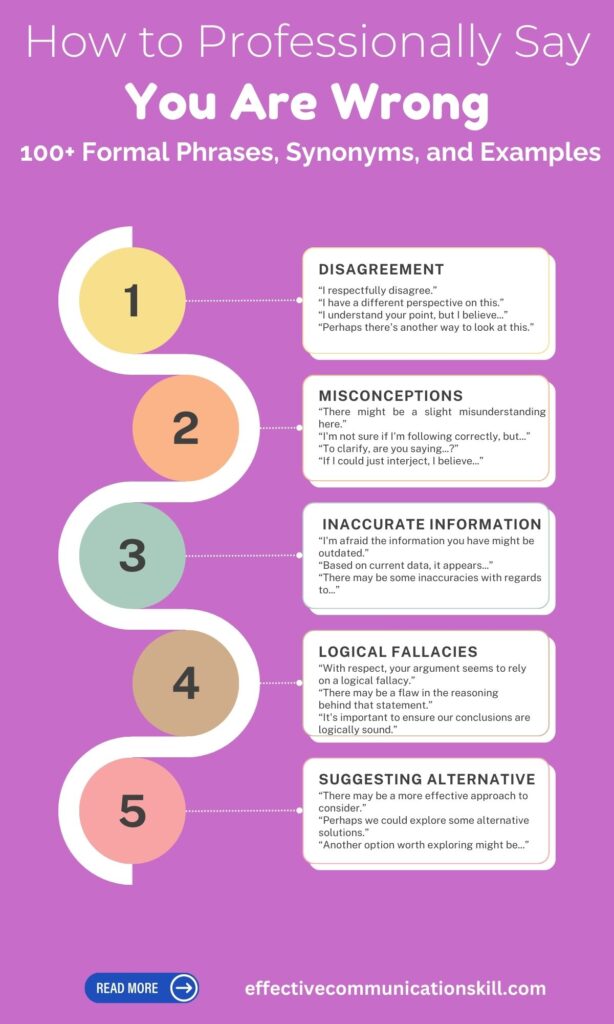
How to Professionally Say You Are Wrong
Here are five tips for how to professionally say you are wrong with grace and politeness:
1. Acknowledge the Error Quickly and Clearly
The sooner you address the issue, the better. Don’t try to downplay it or deflect blame. A simple “I made a mistake” or “I realize I was wrong about…” goes a long way.
Example: During a client meeting, you present outdated sales figures. As soon as you realize the error, pause the presentation and say, “I apologize, I made a mistake. The sales figures I presented are outdated. Here are the most recent numbers…”
2. Explain the Impact
Depending on the situation, briefly explaining how your mistake might have affected the project or team can demonstrate your understanding of the error’s significance.
Example: “This may have caused some confusion regarding our sales targets. Let’s take a moment to review the updated figures and ensure everyone is on the same page.”
3. Take Responsibility and Offer Solutions
Don’t make excuses or point fingers. Show ownership of the mistake and propose a solution to rectify it.
Example: “I take full responsibility for this error. To move forward, I’ll ensure the corrected figures are distributed to everyone and update the sales report accordingly.”
4. Express Your Commitment to Learning
Show that you’re not just focused on fixing the immediate issue, but also on preventing similar mistakes in the future.
Example: “I apologize for any inconvenience this caused. I’m committed to learning from this mistake and will be reviewing our data verification process to ensure greater accuracy moving forward.”
5. Follow Through on Your Commitments
Actions speak louder than words. Make sure you deliver on the solutions you proposed to rectify the situation.
Example: After your presentation error, you diligently update the sales report and send it out to the team along with a revised timeline. This demonstrates your commitment to following through and minimizing the impact of your mistake.
100 Formal Phrases, Synonyms, and Examples to Professionally Say This Is Your Job
Here’s a list of formal phrases and synonyms to professionally say you are wrong:
Disagreement with Explanation:
- I respectfully disagree.
- I have a different perspective on this.
- I understand your point, but I believe…
- Perhaps there’s another way to look at this.
- From my understanding, it seems more like…
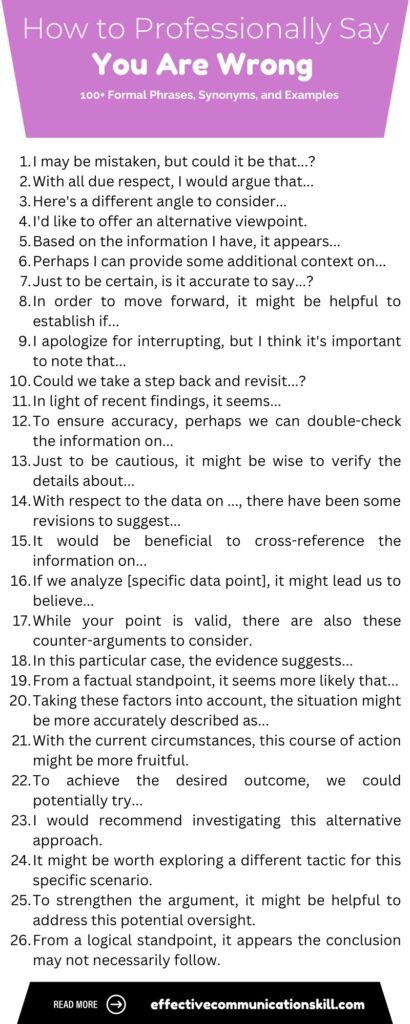
- I may be mistaken, but could it be that…?
- With all due respect, I would argue that…
- Here’s a different angle to consider…
- I’d like to offer an alternative viewpoint.
- Based on the information I have, it appears…
Pointing Out Misconceptions:
- There might be a slight misunderstanding here.
- I’m not sure if I’m following correctly, but…
- To clarify, are you saying…?
- If I could just interject, I believe…
- There seems to be a discrepancy in our understanding of…
- Perhaps I can provide some additional context on…
- Just to be certain, is it accurate to say…?
- In order to move forward, it might be helpful to establish if…
- I apologize for interrupting, but I think it’s important to note that…
- Could we take a step back and revisit…?
Highlighting Inaccurate Information:
- I’m afraid the information you have might be outdated.
- Based on current data, it appears…
- There may be some inaccuracies with regards to…
- It’s important to consider the credibility of the source for…
- If you’re referring to [mention the source], it’s worth noting that…
- In light of recent findings, it seems…
- To ensure accuracy, perhaps we can double-check the information on…
- Just to be cautious, it might be wise to verify the details about…
- With respect to the data on …, there have been some revisions to suggest…
- It would be beneficial to cross-reference the information on…
Disagreement with Evidence:
- I would like to present some evidence that contradicts that notion.
- Perhaps a different interpretation of the data is possible.
- Based on this research, it appears the conclusion might be…
- Let’s consider the following facts that suggest…
- The available data seems to indicate a different outcome.
- If we analyze [specific data point], it might lead us to believe…
- While your point is valid, there are also these counter-arguments to consider.
- In this particular case, the evidence suggests…
- From a factual standpoint, it seems more likely that…
- Taking these factors into account, the situation might be more accurately described as…
Suggesting Alternative Solutions:
- There may be a more effective approach to consider.
- Perhaps we could explore some alternative solutions.
- Have you thought about this strategy as a possibility?
- Another option worth exploring might be…
- Before proceeding, it might be beneficial to consider…
- In similar situations, this method has proven successful.
- With the current circumstances, this course of action might be more fruitful.
- To achieve the desired outcome, we could potentially try…
- I would recommend investigating this alternative approach.
- It might be worth exploring a different tactic for this specific scenario.
Highlighting Logical Fallacies:
- With respect, your argument seems to rely on a logical fallacy.
- There may be a flaw in the reasoning behind that statement.
- It’s important to ensure our conclusions are logically sound.
- If we break down the logic, it seems there might be a missing element.
- To strengthen the argument, it might be helpful to address this potential oversight.
- From a logical standpoint, it appears the conclusion may not necessarily follow.
- Let’s examine the reasoning behind this to ensure its validity.
- While the idea is interesting, it might be lacking a clear cause-and-effect relationship.
- For a more convincing argument, it would be beneficial to address this potential logical gap.
- Perhaps we can reframe the argument to solidify its logical foundation.
Seeking Clarification:
- I’m not quite sure I understand your point. Could you elaborate?
- To ensure I’m on the same page, could you rephrase that?
- Apologies, but I need some clarification on your position regarding…
- Perhaps I can offer some context that might be helpful in understanding…
- Would it be possible to provide some additional details on…?
- Just to be certain, are you suggesting that…?
- If I could just interject for a moment, could you clarify what you mean by…?
- To move forward productively, it would be beneficial to establish a clear understanding of…
- Forgive me for interrupting, but I believe it’s important to define the terms of… before proceeding.
- Perhaps a quick recap of the key points would be helpful for everyone involved.
Suggesting Further Discussion:
- This is an interesting perspective. Perhaps we can discuss it further.
- I appreciate your viewpoint. Would you be open to exploring some alternative ideas?
- Your point raises some valid concerns. Let’s delve deeper into this during our next meeting.
- It seems there might be some differing viewpoints on this issue. Would you be interested in a collaborative discussion?
- This is a complex topic with several facets. Perhaps we can dedicate some focused time to discuss it thoroughly.
- While we may not reach complete agreement, I believe an open discussion would be valuable.
- To ensure we reach the best solution, a collaborative approach might be beneficial.
- I’m confident that through open communication, we can find a common ground.
- Let’s explore this further and see if we can arrive at a mutually agreeable solution.
- Perhaps a brainstorming session could help us generate some creative solutions.
Expressing Tentative Disagreement:
- If I may be so bold, I might offer a slightly different perspective.
- With some reservations, I would suggest that…
- Perhaps there’s another way to look at this, but I could be mistaken.
- Respectfully, I might offer a counterpoint to consider.
- While I understand your reasoning, I have a lingering concern about…
- Forgive me if I’m wrong, but could there be another factor at play here?
- It seems there might be some missing information that could influence the outcome.
- In my experience, a similar situation yielded a different result.
- Just a thought, but perhaps we could consider this alternative approach.
- With all due respect, I would recommend holding off on a decision until we have a clearer picture.
Acknowledging Merit While Disagreeing:
- That’s a fair point, however, I believe there’s another aspect to consider.
- I appreciate your perspective on this. While I agree with [point of agreement], I would argue that…
- You raise a valid concern. Perhaps a compromise solution could be reached by…?
- There’s merit to your approach. However, in this specific case, it might be more effective to try…
- While your suggestion is valuable, the current circumstances might necessitate a different strategy.
- I understand your reasoning, and under different conditions, it might be the best course of action. However, for this situation…
- Your argument has merit, and I acknowledge the potential benefits of your approach. However, have you considered…?
- It’s clear you’ve put significant thought into this. While I may disagree with the conclusion, I appreciate the well-reasoned approach.
- Thank you for bringing this to light. While I may have a different perspective, it’s valuable to consider all viewpoints.
- I see the value in your suggestion. Perhaps we can find a way to incorporate elements of both approaches.
Examples: How to Professionally Say You’re Wrong Using Formal Synonyms
Here are some examples showcasing how to utilize the previously mentioned formal synonyms and phrases in various situations. By using other ways to say you are wrong politely, you can maintain professionalism and foster collaboration.
- Disagreeing with Explanation:
Scenario: In a meeting, a colleague presents a solution that seems flawed.
Formal Response 1 (Disagreement with Explanation): “Thank you for sharing your solution. I understand your reasoning, but I believe there might be a slight misunderstanding regarding [specific point]. Perhaps if we consider [alternative viewpoint], it could lead us to a more effective outcome.”
Formal Response 2 (Suggesting Clarification): “That’s a creative approach. To ensure I fully grasp your idea, could you elaborate on how it would address [specific concern]?”
- Highlighting Misconceptions:
Scenario: A client expresses concerns based on outdated information.
Formal Response 1 (Highlighting Inaccurate Information): “That’s a valid concern. However, based on recent industry data, it appears the situation is actually [provide updated information].”
Formal Response 2 (Suggesting Further Discussion): “Thank you for bringing this to light. While the information you have might be from a previous source, perhaps a quick update on the current landscape would be helpful. Would you be open to a brief discussion on [relevant topic]?”
- Disagreeing with Evidence:
Scenario: During a presentation, a team member presents data that seems misinterpreted.
Formal Response 1 (Disagreement with Evidence): “The data you presented is valuable. However, there might be a different interpretation if we consider [alternative analysis]. This could potentially lead to a conclusion that suggests [alternative outcome].”
Formal Response 2 (Seeking Clarification): “Thank you for sharing this data. To ensure a comprehensive understanding, could you walk us through the methodology used to arrive at these results?”
- Suggesting Alternative Solutions:
Scenario: In a project meeting, a colleague proposes a time-consuming solution.
Formal Response 1 (Suggesting Alternative Solutions): “I appreciate your suggestion for a thorough approach. However, considering the project timeline, perhaps we could explore a more streamlined solution like [alternative approach]?”
Formal Response 2 (Acknowledging Merit While Disagreeing): “That’s a well-considered plan. However, given the resource constraints, a more feasible approach for this specific situation might be [alternative suggestion].”
- Highlighting Logical Fallacies:
Scenario: During a negotiation, a partner makes an argument based on assumptions.
Formal Response 1 (Highlighting Logical Fallacies): “Your point regarding [partner’s argument] is interesting. However, to ensure a sound agreement, it might be beneficial to address the potential assumption that [identify the assumption].”
Formal Response 2 (Appealing to Expertise): “Industry best practices typically recommend establishing a clear foundation for agreements. Perhaps we can consult with a legal expert to ensure both parties are on the same page regarding [specific term]?”
- Seeking Clarification:
Scenario: In a team email, a colleague suggests a change that seems to contradict established protocol.
Formal Response 1 (Seeking Clarification): “Thanks for your suggestion, [colleague’s name]. To ensure we’re aligned with current protocol, could you elaborate on how this change would integrate with the existing [established procedure]?”
Formal Response 2 (Appealing to Authority/Expertise): “Your suggestion regarding [change] is intriguing. However, established company guidelines recommend following [specific protocol] in these situations. Perhaps we can consult with [relevant department] to see if there’s an exception or a recommended adaptation for this specific case?”
- Suggesting Further Discussion:
Scenario: During a client call, a client expresses reservations about a key aspect of the project.
Formal Response 1 (Suggesting Further Discussion): “I understand your concerns about [client’s concern]. This is a crucial aspect of the project, and it’s valuable to ensure complete clarity. Perhaps we can schedule a dedicated follow-up discussion to address your questions and explore potential solutions in more detail.”
Formal Response 2 (Acknowledging Merit While Disagreeing): “Those are valid points, and we appreciate your bringing them to light. While the proposed approach has proven successful in similar projects, we are always open to exploring alternative solutions. Would you be open to brainstorming some additional options together?”
- Expressing Tentative Disagreement:
Scenario: In a committee meeting, a member proposes a drastic change to the budget.
Formal Response 1 (Expressing Tentative Disagreement): “With respect, I appreciate your bold proposal regarding the budget. While significant cost reduction is always desirable, it might be prudent to consider the potential impact on [areas potentially affected]. Perhaps we could explore some alternative cost-saving measures before committing to such a drastic change.”
Formal Response 2 (Suggesting Further Discussion): “That’s certainly an innovative approach to budget allocation. However, before making a final decision, it might be beneficial to analyze the potential long-term consequences of this change. Would you be open to discussing this further with the finance department?”
- Appealing to Authority/Expertise:
Scenario: During a product development meeting, a team member suggests a feature that might have legal implications.
Formal Response 1 (Appealing to Authority/Expertise): “Your suggestion regarding the new feature is interesting. However, it’s crucial to ensure compliance with relevant regulations. Perhaps we can consult with the legal department to confirm the feasibility of implementing this feature before proceeding.”
Formal Response 2 (Expressing Reservations): “I understand the potential benefits of this feature. However, there could be some unforeseen legal ramifications to consider. Perhaps we can explore alternative features that achieve a similar user experience while remaining compliant with all regulations.”
- Creative Disagreement and Collaborative Solutions:
Scenario: In a creative brainstorming session, a teammate presents an idea that seems unoriginal.
Formal Response 1 (Creative Disagreement): “That’s a familiar concept, but what if we gave it a unique twist by [adding an unexpected element]?”
Formal Response 2 (Suggesting Collaborative Refinement): “Interesting idea! Perhaps we can build upon it by incorporating elements from [previous suggestions] to create something truly innovative.”
- Addressing Unrealistic Expectations:
Scenario: During a sales pitch, a potential client expects unrealistic deliverables within a tight timeframe.
Formal Response 1 (Addressing Unrealistic Expectations): “We appreciate your enthusiasm for this project. However, to ensure the highest quality outcome, it’s important to consider a realistic timeline for [specific deliverable]. Perhaps we can discuss a phased approach that delivers key components within your desired timeframe while maintaining the project’s overall quality.”
Formal Response 2 (Suggesting Alternative Solutions): “While we strive to meet all client needs, the complexity of this project might necessitate a slight adjustment to the initial timeline. However, to expedite the process, we could potentially offer [alternative solution] to deliver a core aspect of the project sooner.”
- Presenting Counter-Arguments with Data:
Scenario: In a debate, an opponent makes a claim based on personal opinion.
Formal Response 1 (Presenting Counter-Arguments with Data): “That’s an interesting perspective. However, according to a recent study by [credible source], the data suggests [present opposing data point]. Perhaps we can explore the validity of both viewpoints in light of this new information.”
Formal Response 2 (Shifting the Focus): “While your opinion is valuable, the success of this initiative hinges on achieving measurable results. Let’s shift our focus to exploring data-driven solutions that demonstrably address [core issue].”
- Highlighting Potential Issues with New Ideas:
Scenario: During a product launch meeting, a colleague proposes a marketing campaign with a potentially offensive element.
Formal Response 1 (Highlighting Potential Issues): “The marketing concept has a lot of potential. However, it’s important to consider the potential for misinterpretation by certain demographics. Perhaps we can refine the message to ensure it’s inclusive and resonates with a broader audience.”
Formal Response 2 (Suggesting Alternative Approaches): “I understand the intent behind the campaign, but there might be a more tactful way to convey the message. Perhaps we can explore alternative creative approaches that achieve the same marketing goals while maintaining a positive brand image.”
- Disagreeing with Unethical Proposals:
Scenario: A manager suggests a course of action that seems unethical or could compromise company integrity.
Formal Response 1 (Expressing Reservations): “I have some concerns about the ethical implications of that approach. Our company values [core value] highly. Perhaps we can explore alternative solutions that achieve our goals while maintaining our ethical standards.”
Formal Response 2 (Appealing to Authority/Expertise): “This proposal raises some red flags regarding potential ethical violations. Perhaps we can consult with the legal department to ensure any chosen course of action complies with company policy and all relevant regulations.”
- Responding to Unrealistic Deadlines:
Scenario: A supervisor assigns an overwhelming workload with an unrealistic deadline.
Formal Response 1 (Negotiating a Timeline): “Thank you for the trust you’ve placed in me. However, considering the complexity of this task, the current deadline might be a bit tight. Perhaps we can discuss a more realistic timeframe that ensures high-quality deliverables.”
Formal Response 2 (Suggesting Prioritization): “I’m committed to delivering excellent work. However, this workload seems extensive for the given deadline. Perhaps we can prioritize the most critical tasks and establish realistic completion times for each.”

Conclusion
In the professional world, acknowledging you’re wrong is an essential skill. While it might feel uncomfortable initially, utilizing formal ways to say you are wrong politely can demonstrate your professionalism, integrity, and commitment to learning.
By incorporating the strategies and examples provided throughout this guide, you can effectively navigate situations where you need to admit an error or adjust your approach. Remember, taking responsibility for mistakes and fostering a collaborative environment through open communication are key aspects of building trust and achieving success in any team setting.