
Navigating tricky conversations in the workplace often requires restraint and finesse, even when we’d prefer to express our true thoughts more bluntly. When someone crosses boundaries, makes unreasonable demands, or disregards professional etiquette, a direct response may feel satisfying—but the impact on our reputation or the workplace atmosphere isn’t always worth it.
Instead, knowing how to professionally say fuck off can empower you to assert boundaries and maintain respect without causing unnecessary conflict. This skill isn’t just about rephrasing harsh thoughts; it’s about communicating boundaries in a way that reflects confidence, professionalism, and emotional intelligence.
Whether dealing with pushy colleagues, intrusive questions, or unrealistic expectations, the ability to deflect and redirect assertively can help you uphold your standards while keeping the conversation productive and respectful. Here, we’ll explore tactful, professional alternatives that can subtly, yet firmly, convey the need for distance or a change in approach.
10 Helpful Tips on How to Professionally Say Fuck Off
These professional tips for saying fuck off will help you assert yourself respectfully without crossing lines.
Set Clear Boundaries
Politely clarify your limits to avoid overstepping. For example, “I won’t be able to take this on at the moment” directly communicates that you’re unavailable, allowing the other person to understand where you stand without feeling dismissed or disrespected.
Redirect the Request
Instead of directly refusing, suggest someone else who might be better suited for the task. Saying, “I think [colleague’s name] would be better suited for this” shifts the responsibility elsewhere, keeping the conversation professional and constructive.
Use Polite Detachment
Demonstrate emotional detachment by acknowledging the person’s perspective without further engagement. For instance, saying, “I’ll take that into consideration” shows you’ve heard their point but are not committing to any action, helping you maintain your boundaries.
Stand Firm with Politeness
When someone presses you, it’s important to stay firm without sounding dismissive. Saying, “As mentioned, I’m unable to assist with this right now” reinforces your position and communicates respect for both your time and theirs, without escalating the situation.
Here you like How to Professionally Say No to a Customer? 60 Examples and Tips to convey your message politely
Prioritize Your Schedule
Focus on your current obligations by saying, “My schedule is quite full, so I need to focus on existing commitments.” This reinforces your priorities without sounding abrupt.
Suggest a Future Follow-Up
If someone insists on an immediate response, suggest revisiting the matter at a later time. “Let’s revisit this next month” gives you time to decide and moves the conversation forward, allowing you to avoid conflict in the present while remaining polite.
Deflect Unwanted Input
If someone overreaches, acknowledge their comment but don’t engage deeply. For example, “I’ll keep that in mind, thanks for the insight,” shows appreciation without a commitment.
Politely Decline with Gratitude
When you need to decline, do so respectfully, without burning bridges. Saying, “Thanks for thinking of me, but I’ll have to pass this time” expresses appreciation for the person’s gesture while clearly setting a boundary, ensuring they understand your decision.
Keep Responses Concise
Minimizing engagement helps maintain your professionalism without over-explaining. A simple “Noted” or “Understood” can close a conversation politely, signaling that you’ve heard the message without encouraging further discussion or involvement.
Express Confidence in Their Ability
Redirect a task by empowering the requester. Saying, “I trust you’ll handle it well,” shifts the focus to them and shows confidence in their capabilities.
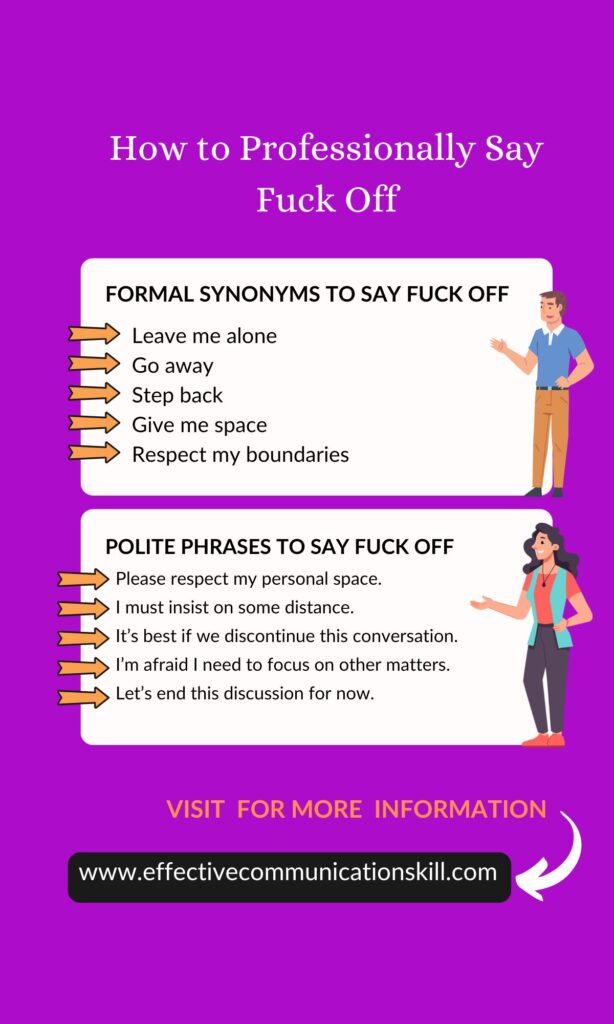
Formal Synonyms to Say Fuck Off
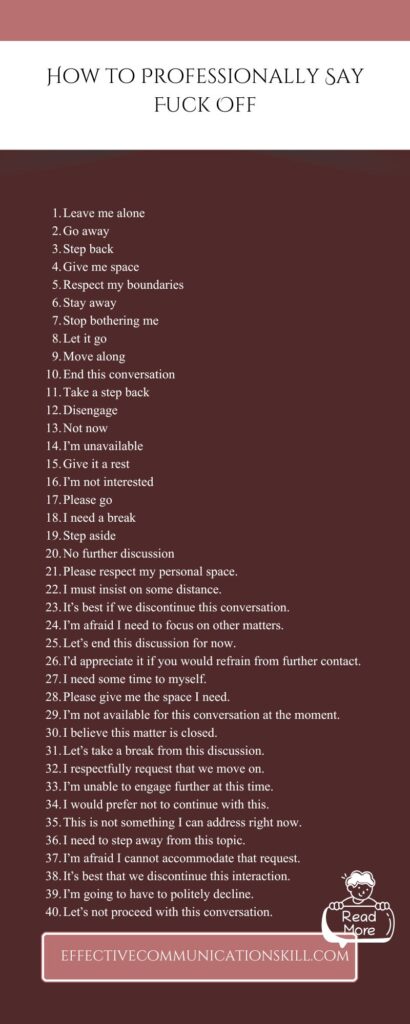
Here are some simple, formal synonyms for “fuck off”:
- Leave me alone
- Go away
- Step back
- Give me space
- Respect my boundaries
- Stay away
- Stop bothering me
- Let it go
- Move along
- End this conversation
- Take a step back
- Disengage
- Not now
- I’m unavailable
- Give it a rest
- I’m not interested
- Please go
- I need a break
- Step aside
- No further discussion
Polite Phrases to Say Fuck Off
Maintaining professionalism while asserting your boundaries is an essential skill. Here are some formal phrases for fuck off that allow you to navigate tough situations gracefully.
- Please respect my personal space.
- I must insist on some distance.
- It’s best if we discontinue this conversation.
- I’m afraid I need to focus on other matters.
- Let’s end this discussion for now.
- I’d appreciate it if you would refrain from further contact.
- I need some time to myself.
- Please give me the space I need.
- I’m not available for this conversation at the moment.
- I believe this matter is closed.
- Let’s take a break from this discussion.
- I respectfully request that we move on.
- I’m unable to engage further at this time.
- I would prefer not to continue with this.
- This is not something I can address right now.
- I need to step away from this topic.
- I’m afraid I cannot accommodate that request.
- It’s best that we discontinue this interaction.
- I’m going to have to politely decline.
- Let’s not proceed with this conversation.
- I think it’s time to end this discussion.
- I must respectfully ask you to leave me be.
- This is outside of my current focus.
- I am not available for further conversation on this.
- I think it’s time for me to disengage.
- I believe we’ve reached the limit of this discussion.
- I need to withdraw from this interaction.
- I would prefer not to entertain this further.
- Please refrain from further attempts to engage.
- Let’s agree to part ways on this topic.
Humorous, funny and Whimsical Ways to Say Fuck Off professionally
Here are funny, humorous, yet still respectful and formal phrases to convey the sentiment of “fuck off”:
- I think it’s time for you to take a long walk off a short pier.
- Let’s schedule a meeting… never!
- Your input is like a Wi-Fi signal—weak and best ignored.
- I’m currently at full capacity for unsolicited advice—thanks!
- I’d love to chat, but I’m on a strict “no you” diet.
- I’m busy right now—can I interest you in a nice long pause?
- Let’s just say your presence is a little too ‘present’ for me.
- I’m on a “people-free” plan—feel free to find your own way!
- I’m in the mood for some quality alone time—enjoy your solitude!
- I appreciate your enthusiasm, but I’m all booked up for “not today.”
- Your energy is vibrant, but I prefer my space privately glowing.
- I’d love to engage, but my schedule just got a sudden case of the “nope.”
- I’m currently in a relationship with my peace and quiet—no interruptions!
- I’m practicing my personal space—please stand at least a few galaxies away.
- I’m on a mission to find my calm—please take a detour!
- Your aura is lovely, but I’m allergic to overexposure.
- I’m in a serious conversation with my coffee—priorities, you know?
- I’m on a quest for tranquility—please don’t disrupt the vibe!
- I’m currently accepting applications for “no thanks”—yours doesn’t make the cut.
- I’m off exploring the wonderful world of “not right now”—care to join?
- I think it’s time for us to hit pause on this conversation.
- I’m going to need you to pretend I’m invisible for a while.
- Let’s take a break from each other—just for my sanity.
- I’m going to kindly ask you to exit stage left.
- Feel free to take your leave at your earliest convenience.
- I believe your services are no longer required at this moment.
- I’m going to let you go—like a balloon floating away.
- It’s time to exit the chat, gracefully and quietly.
- Go ahead and give me some quality alone time—thanks in advance!
- Please consider this my official “we’re done here” moment.
- I’m hitting the ‘do not disturb’ button on you right now.
- I’m going to need you to find another hobby.
- Let’s both pretend this conversation never happened.
- I’d love to continue this, but I’m already mentally on vacation.
- I’m going to leave you with your thoughts… and a door.
- Consider this my polite exit from this interaction.
- I believe you’ve reached the limits of my patience—goodbye.
- I’m going to need you to take your presence elsewhere for a while.
- Now’s a great time for you to vanish like Houdini.
- I think the universe is asking us to take a break from one another.
Here you like How to Say No Professionally in an Email: 55 Examples and tips
100 Other ways to Say Fuck Off Professionally In Several Settings
Effective communication requires respect for others’ speaking time. These polite sentences for saying fuck off will help you politely but firmly address interruptions in any professional environment.
Setting Boundaries with Pushy Colleagues
- “I’m currently focused on a tight deadline and won’t be able to take on additional tasks right now.”
- “I appreciate your enthusiasm, but I’ll need to prioritize other projects first.”
- “I’m afraid I won’t be able to give this my attention at the moment.”
- “At this point, I need to dedicate my time to other responsibilities.”
- “I understand your urgency, but I’m unable to engage with this until later.”
- “Thanks for your input, but I’m in the middle of something and can’t continue this conversation.”
- “I’m currently unavailable to discuss this; let’s pick it up after I finish my current task.”
- “I need to concentrate on my current work right now, but I’ll get back to this when I can.”
- “I’m not able to join in at this moment, but let’s touch base after my meeting.”
- “Please give me some time to handle my current responsibilities before we discuss this further.”
Here you like How to Say No Worries professionally and politely? (50+ Examples and Tips)
Dealing with Unwanted Personal Conversations at Work
- “I prefer to keep personal matters outside of work hours, if that’s alright.”
- “I’m not comfortable discussing personal topics while we’re at the office.”
- “Let’s focus on the work at hand for now; we can catch up another time.”
- “I appreciate your concern, but I’d rather keep that conversation for outside of work.”
- “I need to keep my attention on work-related matters right now.”
- “I think it’s best we save this for a more appropriate time.”
- “Can we please stick to work-related discussions at the moment?”
- “I’m in a professional mindset right now and would like to keep it that way.”
- “I’d prefer to keep things professional during office hours.”
- “Let’s save the personal topics for after work hours; I need to focus right now.”
Responding to Unsolicited Advice or Criticism
- “I appreciate your input, but I’m confident in my approach for now.”
- “Thanks for sharing your thoughts; I’ll continue with the plan I have in mind.”
- “I value your perspective, but I feel comfortable with the direction I’m taking.”
- “I understand your point, but I believe I’ll stick with my current strategy.”
- “Thank you for the feedback, I’ll keep that in mind, but I’m proceeding with my plan.”
- “I appreciate your advice, but I believe I’ve got everything under control.”
- “Thanks for your suggestion, but I’ve already made a decision on this matter.”
- “I’ll consider your input, but I’ll move forward with what I’ve planned.”
- “Thanks for your concern, but I’m comfortable proceeding as is.”
- “I’ll respectfully decline that suggestion, as I have a different approach in mind.”
Avoiding Further Engagement with a Persistent Networker
- “I’m currently booked with meetings for the day, but I’ll connect with you later.”
- “I appreciate your enthusiasm, but I have to focus on other priorities right now.”
- “Thank you for reaching out; I’ll follow up if something comes up.”
- “It’s been great talking, but I need to wrap up now. We can reconnect another time.”
- “I’m afraid I can’t engage right now, but I’ll keep your contact information handy.”
- “Let’s circle back when I have more time to focus on this.”
- “I appreciate your persistence, but I need to move on to another task now.”
- “Thank you, but I’m not available to continue this conversation right now.”
- “I have to excuse myself, but I look forward to connecting at a later date.”
- “I think it’s best we take a break from this conversation for today.”
Here you like How to Professionally Say No to a Request at Work (50+ examples and tips)
Ending a Conversation with a Complaining Colleague
- “I understand your frustrations, but we may need to approach this from a different angle.”
- “I see your point, but I’m not in a position to address this at the moment.”
- “I think we’ve gone over this enough for now. Let’s revisit it after we gather more information.”
- “I understand you’re upset, but I suggest we take a break and continue this later.”
- “It’s clear this issue is important, but let’s table it for now and return to it later.”
- “I think we’ve discussed this enough for now. Let’s move on to other tasks.”
- “I understand where you’re coming from, but I think we’ve exhausted this topic for today.”
- “I hear your concerns, but I need to shift focus to other priorities.”
- “I think it’s time to step away from this conversation and revisit it when emotions have settled.”
- “I appreciate your feedback, but let’s pause this discussion and come back to it after more reflection.”
Politely Declining a Favor or Request
- “I’m afraid I’m unable to assist with that at this time.”
- “I appreciate you thinking of me, but I’ll have to pass on this.”
- “Unfortunately, I’m not in a position to help right now.”
- “I’m already committed to other tasks, so I won’t be able to assist with this.”
- “Thank you for considering me, but I’ll have to respectfully decline.”
- “I’m not available to take this on, but I appreciate your understanding.”
- “I’m unable to help with that, but I hope you find someone who can.”
- “I’m afraid I can’t offer my assistance at this moment.”
- “This isn’t something I can accommodate, but thank you for asking.”
- “I have to focus on my existing commitments, so I won’t be able to take this on.”
Here you like How to Professionally Say No to a Task? 100 Examples and Tips
Dealing with a Boundary-Crossing Boss or Superior
- “I need to focus on my current work, but I’ll follow up once I’m free.”
- “I’d prefer to handle this after I finish my current task.”
- “I’m going to have to respectfully decline for now, but I’ll let you know when I’m available.”
- “I understand your request, but I’m in the middle of something else right now.”
- “I’m unable to engage in this right now, but we can schedule a time to discuss it later.”
- “I need some time to work on this before I can focus on anything else.”
- “I’m not able to give this my attention right now, but I’ll circle back when I’m free.”
- “I appreciate your input, but I’m focused on other priorities at the moment.”
- “Let’s revisit this once I’m able to give it the attention it needs.”
- “I’m in the middle of another project, so I’ll need to decline this for now.”
Handling an Aggressive or Overbearing Customer
- “I understand your frustration, and I’ll ensure your concern is addressed shortly.”
- “I can see this is important to you, but I’ll need to gather more information before moving forward.”
- “Thank you for your patience, but I need a moment to resolve this properly.”
- “I’m going to need you to hold for just a moment while I handle this.”
- “I’m afraid I’ll need to redirect you to the appropriate department to assist further.”
- “I appreciate your business, but I need to conclude this conversation now.”
- “I understand you’re upset, but I can’t help further until we have a clear resolution.”
- “I’m not able to continue this conversation at the moment, but I’ll make sure someone follows up.”
- “We can certainly look into this, but I need to step away for now.”
- “Let me handle this issue, but for now, I need you to allow me some space to resolve it.”
Here are some other ways to say fuck off by utilizing similar words.
How to Professionally Say Back Off
- “I need some space to focus on this, so please allow me to work independently.”
- “I appreciate your enthusiasm, but I need to take the lead on this project for now.”
- “For the time being, I’m handling this task, so please refrain from further involvement.”
- “I believe I have everything under control at this moment, so let’s proceed with separate tasks.”
- “I need to concentrate on this without additional input, so kindly give me some space.”
How to Professionally Say Get Off My Back
- “I have heard your concerns, and I will address them once I have more information.”
- “I’m already working on the issue; please allow me to manage it at my own pace.”
- “I’ve got it covered, and I’ll let you know when I need assistance.”
- “I understand the urgency, but I need the time to properly resolve it without constant follow-ups.”
- “I’m focusing on other priorities at the moment; I’ll circle back to this when I can.”
How to Professionally Say Go to Hell
- “I would prefer not to engage in this discussion any further.”
- “Let’s agree to disagree and move on from this conversation.”
- “I’m not willing to continue this dialogue any longer.”
- “I believe this conversation is no longer productive, so I’ll be ending it here.”
- “It’s clear we have a fundamental disagreement, and I’m stepping away from this topic.”
How to Professionally Tell Someone Off
- “I value professionalism, and I believe we should maintain respectful communication moving forward.”
- “I’m not comfortable with the way this conversation is going, so I think we should pause it.”
- “I believe we need to refocus on the facts and not let emotions guide this discussion.”
- “It’s important that we respect each other’s opinions and approach this matter with a level-headed attitude.”
- “I’m not sure that continuing this conversation is productive at this point, so I suggest we take a break.”

Conclusion
In conclusion, knowing how to professionally say fuck off can be essential for maintaining boundaries in both personal and professional environments. Whether you’re handling a pushy colleague, an overbearing client, or a difficult situation, having the right tools to communicate assertively while keeping professionalism intact is key.
By using respectful language and tactful phrases, you can firmly assert your position without damaging relationships. Mastering these communication skills will allow you to navigate challenging conversations with confidence, ensuring you maintain both your dignity and your professionalism. Remember, it’s not about being rude, but about setting clear boundaries.