
In professional settings, it’s essential to handle communication with poise, even when others become overbearing. We’ve all encountered situations where someone is monopolizing a conversation or veering into territory where silence would be more productive than endless chatter.
However, directly telling someone to “shut up” isn’t exactly conducive to workplace harmony! So, how do you tactfully signal that it’s time for someone to wrap up without damaging your professional image? Here’s where knowing how to say shut up professionally becomes invaluable.
By using considerate phrases and a calm approach, you can guide conversations back on track without coming across as abrupt or impolite. In this post, we’ll explore various ways to subtly and respectfully ask someone to pause, redirect, or reconsider their words, empowering you to maintain a balanced, courteous environment while staying focused on productivity.
Helpful Tips on How to Say Shut Up Professionally
Mastering professional communication requires tact, especially when dealing with interruptions or off-topic discussions. These tips for saying shut up formally, can maintain respect while guiding conversations back on track.
Politely Request to Stay on Topic
When conversations stray off track, a gentle way to refocus is to say, “Can we circle back to the main point?” This approach lets the person know you value their input but need to keep the discussion relevant to the current topic.
Suggest Taking Turns
If someone is dominating a conversation, try saying, “I’d love to hear from others on this as well.” This not only invites other voices into the discussion but also subtly signals that it’s time to let others share their thoughts.
Gently Highlight Time Constraints
When someone’s lengthy comments are impacting productivity, say, “We’re a bit short on time, so let’s keep it concise.” This lets them know that while their thoughts are valued, brevity is necessary to respect everyone’s time.
Offer to Continue Later
For conversations that are dragging on, use a phrase like, “This is great—perhaps we can pick it up offline?” This approach keeps things moving smoothly by suggesting a more appropriate time to continue without dismissing their input.
Acknowledge and Redirect
Acknowledge their point to show you’re listening, then guide the conversation forward: “I see where you’re coming from. To build on that…” This helps them feel heard while you steer the conversation back on track.
Here you like 500+ Other Ways to Say Good Evening – Synonyms, phrases from funny, cute, creative to professionally settings
Encourage Conciseness
For someone who tends to over-explain, you can say, “Could you summarize your main points?” This politely asks for brevity and shows you’re interested in getting to the core of their message.
Use Humor to Diffuse
If the conversation needs a friendly nudge, try, “You’re on a roll! But let’s give others a chance to chime in.” This lighthearted approach keeps things upbeat while gently reminding them to pause.
Mention the Agenda
In group meetings, help keep things on track by saying, “To stay aligned with our agenda, let’s keep discussions brief.” This frames brevity as a collective goal, respecting everyone’s time and the meeting structure.
Empathize, Then Move On
If someone is going off on a tangent, acknowledge their point with, “I get it. Now, let’s focus on…” This shows empathy and understanding, followed by a shift to the topic at hand to keep the conversation moving.
Ask for Others’ Perspectives
When one person is monopolizing the conversation, invite other input by saying, “I’d like to get a few more thoughts on this.” This signals that it’s time to wrap up and ensures everyone has a chance to contribute.
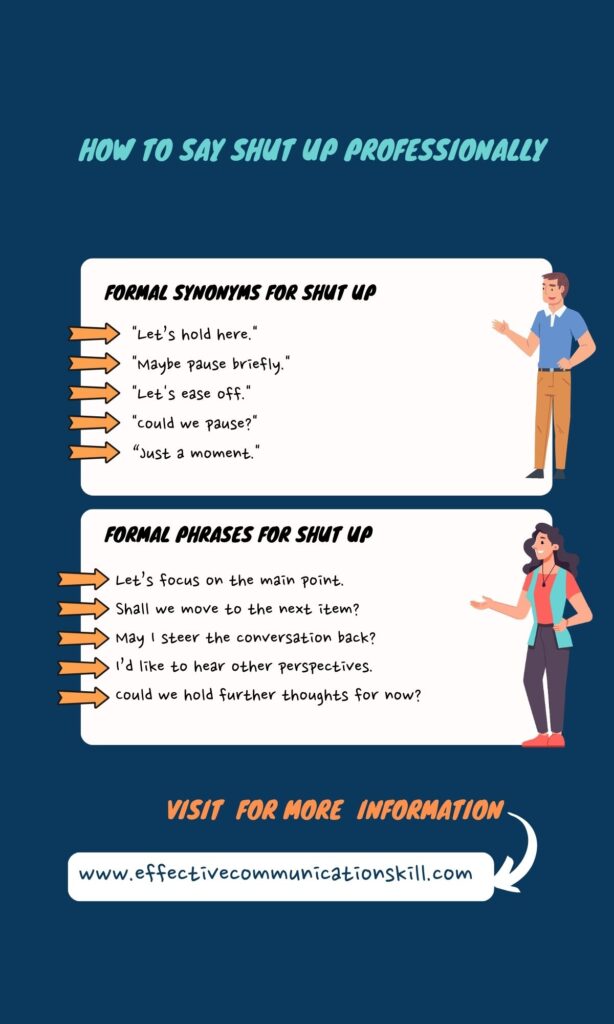
Formal Synonyms For Shut Up
- “Let’s hold here.”
- “Maybe pause briefly.”
- “Let’s ease off.”
- “Could we pause?”
- “Just a moment.”
- “Let’s take a beat.”
- “If we could pause.”
- “Perhaps hold back.”
- “Let’s keep it brief.”
- “Shall we continue?”
- “Let’s settle a bit.”
- “Just one moment.”
- “Let’s stay focused.”
- “Let’s circle back.”
- “Let’s step aside.”
- “Shall we defer?”
- “Maybe wait a sec.”
- “Perhaps save that.”
- “Let’s hold off.”
- “Let’s keep still.”
Here you like 500+ Different Ways to say Good Afternoon (Synonyms, phrases and examples)
Note: Some of these phrases may be more or less formal than others, but they all convey the same meaning as “shut up.”
Formal Phrases For Shut Up
In professional settings, it’s crucial to redirect conversations without being harsh. Formal phrases to say shut up ensure that discussions stay on point while maintaining a courteous tone.
- Let’s focus on the main point.
- Shall we move to the next item?
- May I steer the conversation back?
- I’d like to hear other perspectives.
- Could we hold further thoughts for now?
- Let’s table this for a later discussion.
- Let’s shift gears to stay on track.
- For the sake of time, let’s proceed.
- We’ll revisit this when time permits.
- Let’s keep our focus streamlined.
- Perhaps we can pause here and continue later.
- Let’s prioritize other viewpoints.
- Allow me to interject to keep us on course.
- I suggest we save this for another time.
- Let’s capture that thought for later.
- Let’s keep the discussion on point.
- Please allow us to move forward.
- In the interest of time, let’s conclude here.
- Let’s focus on actionable points.
- Could we revisit this topic later?
- Shall we maintain a streamlined discussion?
- Let’s allocate time for others to contribute.
- Let’s respect the time and keep it brief.
- Let’s transition back to the agenda.
- To stay on schedule, let’s continue.
- May I guide us back to the topic?
- Let’s summarize to move forward.
- Could we wrap up this thought?
- Let’s remain within our scope for now.
- I’ll bring us back to the agenda.

Sarcastic and Funny Ways to Say Shut Up professionally
Here are some humorous yet polite ways to say shut up in a professional tone, adding a touch of wit without losing decorum:
- Let’s put a bookmark in that thought.
- Hold that brilliance for just a moment.
- We’re going to hit “pause” on that enthusiasm.
- Your passion is noted; let’s save some for later.
- Let’s let that idea simmer on the back burner.
- Hold onto that nugget of wisdom; we’ll circle back.
- Let’s give the microphone a quick break.
- I think we’ve reached peak insight here—let’s move on.
- Let’s press “mute” on that idea for a second.
- Hold that genius! We’ll revisit it soon.
- Let’s cap that enthusiasm for a moment.
- Let’s wrap up this TED Talk and move on.
- Your point is bookmarked—let’s continue.
- That’s a golden idea; let’s vault it for now.
- Let’s hit “pause” on your brilliance here.
- Hold that energy; it’ll keep until later.
- Let’s save some wisdom for the next meeting.
- Let’s press “fast forward” and skip ahead.
- You’re on a roll! Let’s let others catch up.
- Your enthusiasm is infectious; let’s channel it forward.
- Let’s put a pin in that, shall we?
- Your enthusiasm is truly overwhelming—let’s save some for later!
- How about we hit the pause button on that thought?
- Fascinating insight! I’m going to let that marinate for a while.
- I appreciate your input—let’s file that under “future reference.”
- Hold that thought! I’ll get back to you after my coffee break.
- Wow, you have so much to say! Let’s give your words a little vacation.
- That’s an interesting perspective—let’s schedule a time for silence.
- Your words are like a great novel—let’s save some chapters for later!
- I love where you’re going with this! How about we take a scenic detour?
- You’re a fountain of knowledge! Let’s turn off the tap for now.
- I’m collecting thoughts today—yours will go in the “someday” box.
- Your passion is inspiring! Let’s dial it back to a gentle whisper.
- I’m on a strict diet of minimal chatter—let’s skip the appetizer.
- Let’s bookmark that for now—there’s a lot to digest!
- That’s a lot of great information! How about we save some for a rainy day?
- Your verbosity is impressive! How about a moment of silence?
- I’m really enjoying this monologue—let’s intermission for a bit.
- I see you’re eager to share! Let’s postpone until further notice.
- Your dialogue is a symphony! Let’s take a pause for a breath.
Here you like 600+ Other Ways to say Good Morning in personal, professional and Relationship settings
70 Useful Sentences to Say Shut up Professionally In Several Settings
Knowing how to effectively communicate in different environments is essential. These professional sentences for saying shut up provide diverse, professional ways to redirect conversations across various workplace settings.
Navigating Difficult Conversations
- “I appreciate your insights, but let’s focus on our main objective.”
- “Those are valid points, but I think we should consider the opinions of others as well.”
- “I see you’re passionate about this topic; however, let’s try to keep our discussion brief.”
- “Your enthusiasm is great, but can we table this for now and move forward?”
- “Let’s save that discussion for another time and redirect our focus to the agenda.”
- “Let’s take a moment to regroup and ensure everyone is heard.”
- “I appreciate your thoughts, but let’s allow others to weigh in as well.”
- “Your passion is clear, but let’s keep our comments brief to cover all points.”
- “Let’s park that idea for now and come back to it later.”
- “While I understand your perspective, we need to consider the bigger picture.”
Enhancing Communication Skills
- “I’d like to hear more perspectives before we dive deeper into this issue.”
- “Could we summarize our thoughts to keep the discussion on track?”
- “Let’s streamline our conversation to ensure everyone has a chance to contribute.”
- “That’s an interesting point; perhaps we can revisit it later.”
- “To keep things efficient, let’s focus on the key points for today’s meeting.”
- “I encourage everyone to keep their comments concise so we can address all topics.”
- “That’s a compelling viewpoint; let’s jot it down for future discussion.”
- “To maximize our efficiency, let’s prioritize the most pressing issues.”
- “Let’s keep the dialogue focused; I’d love to hear from others as well.”
- “As we wrap up this section, let’s make sure all voices are heard.”
Managing Workplace Dynamics
- “I value your contributions, but let’s ensure everyone has an opportunity to speak.”
- “Thank you for your thoughts; let’s allow others to share their ideas as well.”
- “While I appreciate your enthusiasm, let’s make sure we stay on topic.”
- “It’s important to hear from the entire team; can we pause here?”
- “Let’s respect everyone’s time and keep our discussion succinct.”
- “Thank you for your enthusiasm; let’s allow others to share their insights now.”
- “I appreciate your perspective; however, let’s keep our responses brief.”
- “To foster collaboration, we need to give everyone a chance to contribute.”
- “It’s great to see such engagement; let’s channel that into concise remarks.”
- “I understand you have strong feelings about this, but let’s stay focused on our agenda.”
Preparing for Specific Situations
- “As we move forward, I encourage everyone to share their brief thoughts.”
- “Before we proceed, let’s make sure we’re aligned on our main objectives.”
- “I’d like to guide us back to our original topic as we approach the end of our time.”
- “To keep things moving, let’s limit our responses to two minutes each.”
- “I appreciate your input, but let’s save detailed discussions for our next meeting.”
- “In the interest of time, let’s keep our responses limited to two key points.”
- “As we move forward, I’d like us to stick to the essentials.”
- “Before we go any further, let’s ensure we’re all aligned on our goals.”
- “I encourage everyone to keep their contributions succinct as we wrap up.”
- “Let’s summarize our thoughts quickly so we can address the next item.”
Here you like How to Professionally Say No to a Job Offer: 50+ Formal examples and tips
Learning Formal Language
- “To ensure clarity, let’s focus on the most relevant points in our discussion.”
- “While that’s an interesting idea, I suggest we save it for a future conversation.”
- “Let’s keep our dialogue concise to make the best use of our time.”
- “I’d like to emphasize the importance of maintaining our agenda.”
- “Can we please refrain from going off on tangents and stick to our main topic?”
- “To maintain clarity, let’s avoid digressing from our primary discussion.”
- “I appreciate your insights, but let’s focus on what’s directly relevant.”
- “To keep the flow going, let’s refrain from lengthy explanations.”
- “Shall we prioritize the most urgent topics and revisit others later?”
- “Let’s ensure our conversation remains focused and productive.”
Here are some other ways to say Shut up by utilizing its similar words. These enhancements add more context and professionalism to each response while maintaining the original intent.:
How to Say Be Quiet Professionally
- “Could we please have a moment of silence to reflect thoughtfully on this important topic?”
- “I would greatly appreciate it if we could pause the conversation for the time being to gather our thoughts.”
- “Let’s take a brief moment to collect our ideas and reflect before continuing with our discussion.”
- “Can we hold off on any further comments while we take the time to consider the next steps in our process?”
- “I think it would be beneficial for everyone involved to take a brief pause in our discussion to ensure clarity.”
How to Professionally Say Think Before You Speak
- “I encourage you to take a moment to carefully consider your response before sharing your thoughts with the group.”
- “It might be helpful to reflect on that point for a moment before articulating your thoughts in the discussion.”
- “Let’s ensure we take adequate time to think through our statements carefully to foster meaningful dialogue.”
- “I suggest we pause briefly and evaluate our comments before proceeding to ensure effective communication.”
- “Please consider the implications of your words before we continue so that we can maintain a constructive atmosphere.”
Here you like How to Say No Comment Politely or Professionally (120+ examples and tips)
How to Professionally Say I Don’t Like Your Tone
- “I believe the tone of our conversation could be more constructive to facilitate better collaboration and understanding.”
- “It seems that the current tone may not foster the most positive dialogue necessary for our teamwork.”
- “I would appreciate it if we could adopt a more collaborative approach to this discussion to enhance communication.”
- “Can we adjust the tone of our conversation to be more respectful and supportive of everyone’s input?”
- “I feel that adopting a different tone might help us communicate more effectively and achieve our goals together.”
How to Professionally Say I Don’t Like It
- “I have some reservations about this approach, as I believe it may not align well with our overall objectives.”
- “I believe there are aspects of this that may not align with our goals and the vision we’re trying to achieve.”
- “This option does not resonate well with my perspective, and I think we should explore alternatives.”
- “I’m concerned that this may not be the best fit for our needs, and I would like to discuss other options.”
- “I would prefer to explore alternative solutions to this matter, as this approach does not seem to be effective.”

Conclusion
In navigating professional environments, effective communication is essential, especially when addressing challenging conversations. Learning how to say shut up professionally allows you to maintain respect and decorum while guiding discussions toward productive outcomes.
By employing tactful phrases and thoughtful strategies, you can gently redirect conversations and encourage more constructive dialogue. Remember, it’s not just about silencing someone; it’s about fostering a collaborative atmosphere where all voices are valued. With these techniques, you’ll be better equipped to handle difficult interactions while preserving professionalism and promoting a positive workplace culture.