
How to say no worries professionally
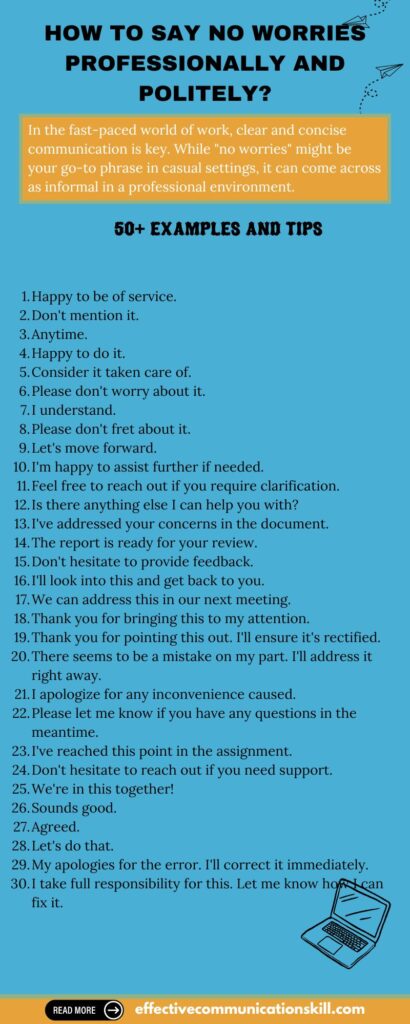
In the fast-paced world of work, clear and concise communication is key. While “no worries” might be your go-to phrase in casual settings, it can come across as informal in a professional environment.
Did you know that a study by the American Psychological Association found that above 60% of employees report feeling stressed about communication in the workplace?
Clear and concise communication is essential for building trust, avoiding misunderstandings, and fostering a productive work environment. Yet, even the most confident professionals can stumble when it comes to casually saying “no worries” in response to a colleague’s thanks or apology.
This post will equip you with a variety of professional alternatives to express the same sentiment, ensuring smooth and effective communication at work.
How to Say No Worries POLITLY?
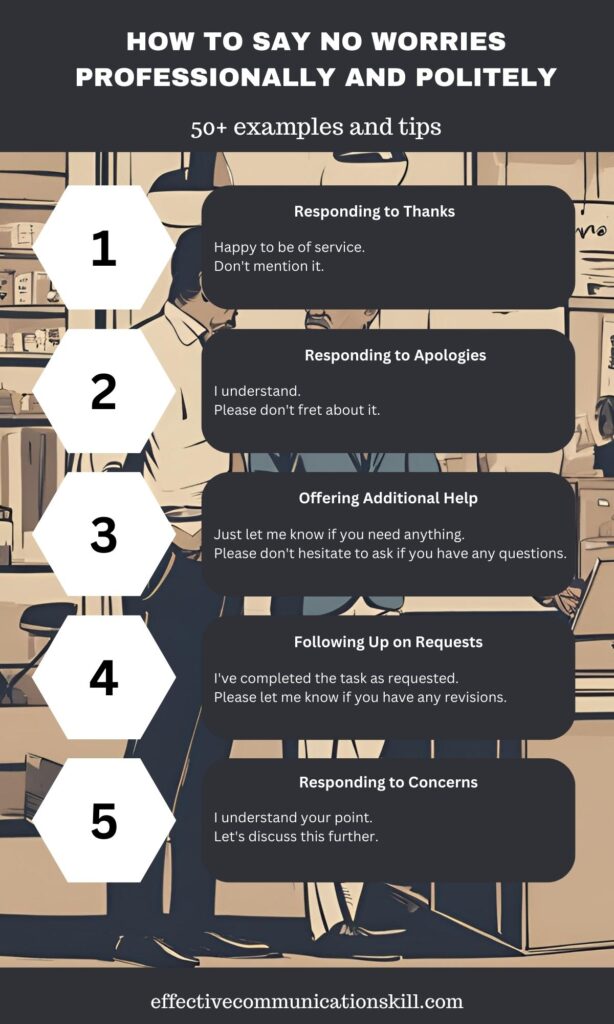
Here are five Polite and Professional ways to say no worries in different situations:
Acknowledging Thanks: Replace “no worries” with “You’re welcome” or “Happy to help” after someone thanks you for your assistance. (Example: “You’re welcome!” or “Happy to help with the report.”)
Reassuring After an Apology: When someone apologizes for a minor inconvenience, use “No problem” or “Don’t worry about it.” (Example: “No problem at all” or “Don’t worry about it, these things happen.”)
Offering Help: Instead of “no worries” when someone hesitates to ask for help, use “Absolutely” or “Certainly.” (Example: “Absolutely, let me know if you need anything.” or “Certainly, I’m happy to assist.”)
Following Up: When confirming you’ve addressed their concern, opt for “Consider it handled” or “I’ve taken care of it.” (Example: “Consider it handled, the report is ready.” or “I’ve taken care of the typo, the email has been resent.”)
Expressing Understanding: If someone expresses concern, use “I understand” or “Of course” to acknowledge their feelings. (Example: “I understand your concerns, let’s discuss them further.” or “Of course, I’ll be sure to keep you updated.”)
50+ Ways to Say No Worries professionally at Work
Here’s a comprehensive list categorized by specific situations:
Responding to Thanks:
- You’re welcome.
- My pleasure.
- Happy to be of service.
- Don’t mention it.
- Anytime.
Interesting to know: HOW TO PROFESSIONALLY SAY NO TO A REQUEST AT WORK (50+ EXAMPLES AND TIPS)
Reassurance After Minor Inconveniences:
- No problem at all.
- It was nothing.
- Happy to do it.
- Consider it taken care of.
- Please don’t worry about it.
Responding to Apologies:
Here are some examples on How to say no need to apologize:
- No worries.
- There’s no need to apologize.
- I understand.
- Please don’t fret about it.
- Let’s move forward.
Offering Additional Help:
Here are some examples on How to professionally say no pressure:
- Just let me know if you need anything.
- Please don’t hesitate to ask if you have any questions.
- I’m happy to assist further if needed.
- Feel free to reach out if you require clarification.
- Is there anything else I can help you with?
Following Up on Requests:
- I’ve completed the task as requested.
- Please let me know if you have any revisions.
- I’ve addressed your concerns in the document.
- The report is ready for your review.
- Don’t hesitate to provide feedback.
Responding to Concerns:
- I understand your point.
- Let’s discuss this further.
- I’ll look into this and get back to you.
- We can address this in our next meeting.
- Thank you for bringing this to my attention.
Accepting Tasks/Assignments:
- Absolutely.
- I’m on it.
- Consider it done.
- Understood. I’ll get started right away.
- Happy to take this on.
Taking Responsibility for Mistakes:
- My apologies for the error. I’ll correct it immediately.
- I take full responsibility for this. Let me know how I can fix it.
- Thank you for pointing this out. I’ll ensure it’s rectified.
- There seems to be a mistake on my part. I’ll address it right away.
- I apologize for any inconvenience caused.
Providing Updates on Progress:
- I’m making good progress on the project.
- The task is on track for completion by [date].
- I’ll keep you updated on any developments.
- Please let me know if you have any questions in the meantime.
- I’ve reached this point in the assignment.
Offering Encouragement or Support:
- Good luck with your presentation!
- I’m confident you’ll do great.
- Please let me know if there’s anything I can do to help.
- Don’t hesitate to reach out if you need support.
- We’re in this together!
Expressing Agreement or Confirmation:
- Sounds good.
- Agreed.
- Let’s do that.
Additional Tips for Professional Communication:
- Match Your Tone to the Situation: While these phrases offer a variety of options, remember to tailor your response to the specific situation. A formal apology for a significant error would require a different tone than a quick reassurance to a colleague.
- Body Language Matters: Maintain professional eye contact, a confident posture, and a friendly smile when delivering your response. Non-verbal cues can significantly enhance your message.
- Consider the Medium: When responding via email, maintain a professional tone throughout the message. Even if you’re using a phrase like “Absolutely” to accept a task, avoid excessive exclamation points or overly informal language.
- Be Clear and Concise: Getting straight to the point is essential in professional communication. Choose the most appropriate phrase from the list and avoid overly elaborate explanations.
Examples of Applying These Tips:
Scenario 1: A colleague thanks you for helping them with a report.
Informal: “No worries!”
Professional: “You’re welcome. Happy to help!” (Friendly and acknowledges your willingness to assist)
Scenario 2: Your manager assigns you a new project.
Informal: “Alright, cool.”
Professional: “Absolutely. I’m on it.” (Shows enthusiasm and immediate action)
Scenario 3: You accidentally send an email with a typo.
Informal: “Ugh, I messed up! Sorry!”
Professional: “My apologies for the error in the previous email. I’ve sent a corrected version. Please let me know if you have any questions.” (Takes responsibility and offers to help further)
Conclusion
Mastering the art of professional communication takes practice, but with these tips and the extensive list of alternatives, you’re well on your way to ditching “no worries” in favor of clear, concise, and professional responses.
Remember, effective communication builds trust, fosters collaboration, and ultimately leads to a more positive and productive work environment. So, the next time you want to express that something isn’t a problem, reach for one of these professional phrases and watch your communication skills soar!