
In professional settings, even the most seemingly casual phrases can leave lasting impressions. Take, for example, the simple expression “just in case.” While effective in informal conversations, it might lack the polish needed for professional communication.
Whether you’re drafting an email, preparing a presentation, or having a conversation with colleagues, finding an elevated way to convey the same message can showcase foresight, clarity, and attention to detail. That’s why learning how to say just in case professionally is a valuable skill.
It’s not just about sounding formal; it’s about ensuring your tone aligns with the environment while maintaining the phrase’s meaning. In this article, we’ll explore refined alternatives to “just in case” that work seamlessly in various scenarios, from offering backup plans to emphasizing precautions. These tips will help you strike the perfect balance between professionalism and practicality. Let’s dive in!
10 Helpful Tips on How to Say Just in Case Professionally
These tips for saying just in case will help you strike the perfect balance between professionalism and practicality. Let’s dive in!
1. Emphasize Preparedness
Instead of “just in case,” use “to ensure preparedness” to convey professionalism. For example, “I’m providing these additional details to ensure preparedness for the meeting, so we’re ready for any questions that arise.”
2. Highlight Contingency Planning
Opt for “as a precautionary measure” to sound polished while emphasizing forethought. For instance, “We’ve added extra resources as a precautionary measure to ensure smooth project completion even if unexpected issues occur.”
Here you like How to Professionally Say No to a Job Offer: 50+ Formal examples and tips
Phrases and Sentences)
3. Focus on Proactive Measures
Use “to cover all eventualities” to communicate readiness for any scenario. Example: “I’ve included a backup file to cover all eventualities during the presentation, ensuring we’re equipped to handle any technical glitches.”
4. Reference Backup Support
Choose “in case it becomes necessary” to express careful consideration of potential needs. For example, “I’ve shared the alternate plan in case it becomes necessary to pivot due to unforeseen changes.”
5. Indicate Thoughtfulness
Say “to anticipate potential needs” to highlight your attention to detail. For instance, “I’ve prepared these materials to anticipate potential needs during the workshop, ensuring attendees have everything required for success.”
6. Convey Thoroughness
Phrase it as “to account for all possibilities” to show your commitment to being comprehensive. Example: “I’ve outlined a timeline to account for all possibilities during the project, ensuring we’re prepared for any deviations.”
7. Stress Risk Mitigation
Use “as a safeguard against potential challenges” to demonstrate your strategic thinking. Example: “We’ve scheduled a follow-up meeting as a safeguard against potential challenges that might arise during the implementation phase.”
8. Refer to Alternative Plans
Opt for “to provide a fallback option” to emphasize your proactive planning. For example, “This document is shared to provide a fallback option should we need to address unexpected outcomes.”
9. Emphasize Careful Planning
Say “to ensure nothing is overlooked” to underline your thorough approach. Example: “I’ve double-checked the data to ensure nothing is overlooked in our analysis, minimizing the risk of errors.”
10. Highlight Extra Measures
Use “to offer additional support” to show your commitment to collaboration. Example: “These resources have been compiled to offer additional support during the rollout, ensuring the team has everything it needs.”
These synonyms will help you express precaution effectively in professional communication.
30 Formal Phrases to Say Just in Case
Here are different formal phrases for saying just in case, ensuring clarity and a polite tone when preparing for contingencies.
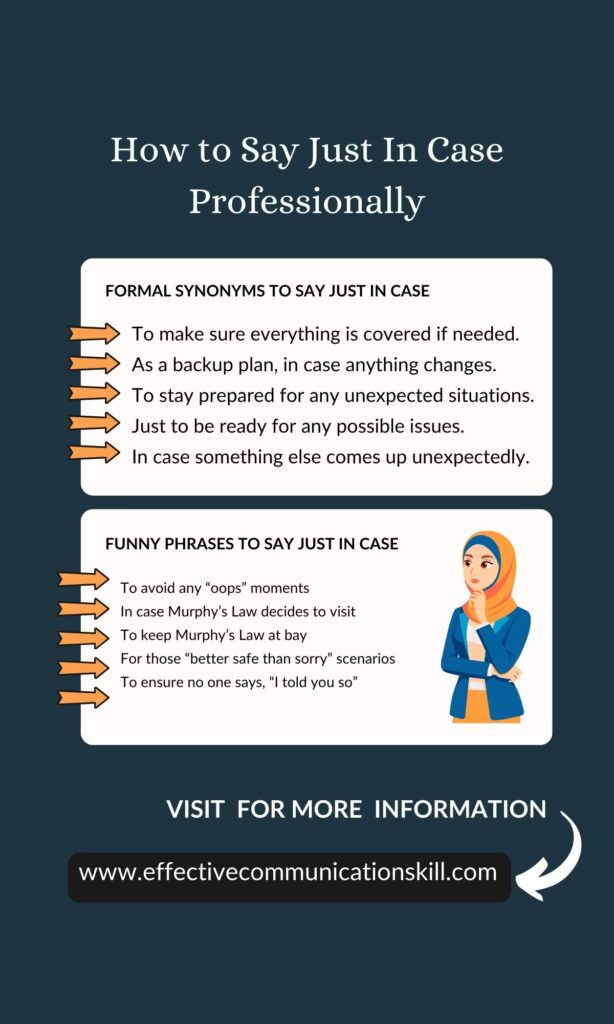
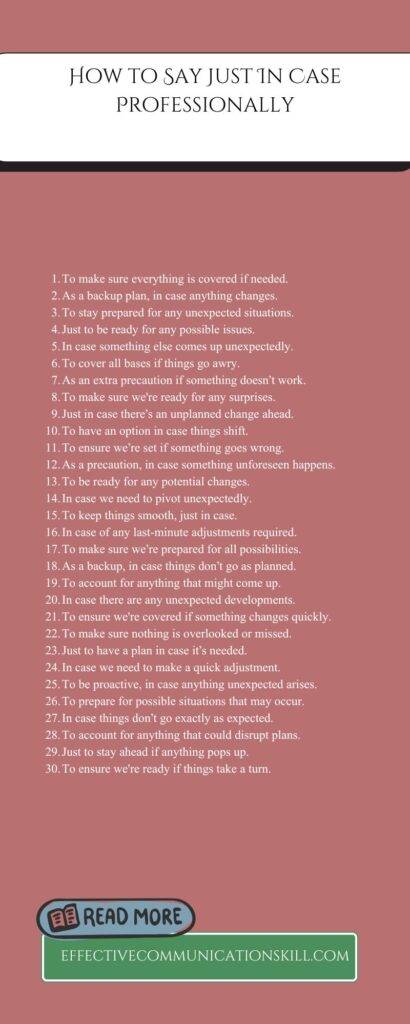
- To make sure everything is covered if needed.
- As a backup plan, in case anything changes.
- To stay prepared for any unexpected situations.
- Just to be ready for any possible issues.
- In case something else comes up unexpectedly.
- To cover all bases if things go awry.
- As an extra precaution if something doesn’t work.
- To make sure we’re ready for any surprises.
- Just in case there’s an unplanned change ahead.
- To have an option in case things shift.
- To ensure we’re set if something goes wrong.
- As a precaution, in case something unforeseen happens.
- To be ready for any potential changes.
- In case we need to pivot unexpectedly.
- To keep things smooth, just in case.
- In case of any last-minute adjustments required.
- To make sure we’re prepared for all possibilities.
- As a backup, in case things don’t go as planned.
- To account for anything that might come up.
- In case there are any unexpected developments.
- To ensure we’re covered if something changes quickly.
- To make sure nothing is overlooked or missed.
- Just to have a plan in case it’s needed.
- In case we need to make a quick adjustment.
- To be proactive, in case anything unexpected arises.
- To prepare for possible situations that may occur.
- In case things don’t go exactly as expected.
- To account for anything that could disrupt plans.
- Just to stay ahead if anything pops up.
- To ensure we’re ready if things take a turn.
Funny Ways to Say “Just in Case”
Here are some funny yet respectful ways to say “just in case” that will keep things both professional and engaging.
- To avoid any “oops” moments
- In case Murphy’s Law decides to visit
- To keep Murphy’s Law at bay
- For those “better safe than sorry” scenarios
- To ensure no one says, “I told you so”
- In the event things take a creative turn
- To preempt any curveballs life might throw
- For when Plan A feels adventurous
- To prepare for surprises we didn’t RSVP for
- To handle any “plot twists” gracefully
- For those moments when life laughs at our plans
- To stay ahead of any “surprise challenges”
- In case the universe wants to keep us humble
- To avoid a “should’ve, could’ve, would’ve” situation
- For when “better safe than unprepared” applies
- To ensure we have a Plan B, or C, or Z
- In case reality decides to improvise
- To sidestep any uninvited chaos
- For those “you didn’t see that coming” moments
- In case the backup plan needs a backup plan
80 Example Sentences to Say Just In Case Professionally In Several Settings
In various professional settings, it’s important to communicate readiness and caution effectively. These 100 example professional sentences for saying just in case offer practical, scenario-based phrases to help you use “just in case” professionally across diverse situations.
Examples for Writing Formal Emails
- “I’ve attached the updated document to ensure all information is accessible if needed.”
- “To account for any unforeseen questions, I’ve included additional details below.”
- “I’m sharing these resources as a precautionary measure for our discussion.”
- “Please find the backup plan attached to address any unexpected challenges.”
- “To ensure preparedness, I’ve copied relevant stakeholders on this email.”
- “I’m providing these instructions as a safeguard against any potential issues.”
- “For your convenience, I’ve included alternate contact details.”
- “To anticipate potential needs, I’ve outlined additional scenarios.”
- “As a precaution, please review the appended checklist.”
- “I’ve included the previous version for reference in case it’s useful.”
Here you like How to Say You’re Welcome Professionally (200 Formal Synonyms, Phrases and Sentences)
Examples for Creating Presentations
- “These slides have been added to address any unforeseen audience questions.”
- “To ensure clarity, I’ve included an additional example on this topic.”
- “This chart is provided as a fallback option for explaining complex data.”
- “For your reference, here’s a breakdown of alternate methods.”
- “To anticipate potential inquiries, we’ve prepared a detailed Q&A slide.”
- “I’ve added these figures to account for all possibilities in our analysis.”
- “This appendix section is included for additional context, if required.”
- “To ensure seamless delivery, we’ve uploaded a backup copy of the presentation.”
- “A contingency plan is included in case there are last-minute changes.”
- “These visual aids were prepared to clarify unexpected questions.”
Examples for Client Communication
- “To ensure a smooth process, we’ve included additional resources for your review.”
- “I’ve attached an alternative timeline for your consideration in case it suits your needs better.”
- “To account for potential delays, we’ve outlined contingency plans in the attached document.”
- “I’m sharing this updated report to cover any overlooked aspects.”
- “As a proactive measure, we’ve included extra team members for support.”
- “To anticipate your requirements, I’ve added supplementary information to the proposal.”
- “In case adjustments are needed, we’ve included a flexible plan in our strategy.”
- “This document is shared as an extra layer of assurance for project success.”
- “To address unforeseen circumstances, we’ve outlined backup options in detail.”
- “To provide a comprehensive service, I’ve included additional examples for context.”
Examples for Job Applications
- “To ensure your convenience, I’ve attached all necessary documents.”
- “I’ve included my portfolio link in case you need further examples of my work.”
- “To provide a complete overview, I’ve attached an additional recommendation letter.”
- “As a precautionary measure, I’ve included my contact details in multiple formats.”
- “I’ve added a detailed description of my previous roles to cover any queries.”
- “This supplementary document outlines my achievements, should you require them.”
- “For your convenience, I’ve included both PDF and Word versions of my resume.”
- “I’ve provided alternative times for the interview to accommodate your schedule.”
- “To ensure a seamless application process, I’ve addressed potential concerns in my cover letter.”
- “I’ve added my availability for follow-ups in case further discussion is required.”
Examples for Travel or Event Planning
- “To account for unforeseen delays, I’ve included an extra hour in the itinerary.”
- “This checklist ensures all essentials are covered for the trip.”
- “To handle unexpected weather, I’ve suggested alternate outdoor activities.”
- “I’ve prepared a backup venue in case the original location isn’t available.”
- “To provide flexibility, I’ve included additional flight options for your review.”
- “This plan includes contingency arrangements for any logistical challenges.”
- “For convenience, I’ve mapped out alternative routes to the destination.”
- “These additional bookings were made as a safeguard against cancellations.”
- “To ensure all preferences are accommodated, I’ve outlined multiple menu options.”
- “This schedule was designed with buffer times to avoid potential overlaps.”
Examples for Healthcare or Emergency Preparedness
- “To be prepared, I’ve packed a first aid kit for emergencies.”
- “This list includes medications that might be needed as a precaution.”
- “To ensure readiness, we’ve identified alternate providers for urgent care.”
- “These instructions are shared to address any unexpected symptoms.”
- “As a safeguard, we’ve noted all nearby hospitals and their contact details.”
- “To handle potential delays, I’ve included additional health supplies.”
- “This form ensures all medical history details are readily available.”
- “To mitigate risks, we’ve arranged for supplementary insurance coverage.”
- “These guidelines provide steps for addressing emergencies effectively.”
- “As a precaution, I’ve informed the team of emergency response protocols.”
Here you like How to Professionally Say I Don’t Care (200 Formal Synonyms, Phrases and Sentences)
Examples for Financial Planning
- “This savings plan accounts for unforeseen expenses in the future.”
- “To provide a safety net, an emergency fund has been established.”
- “These additional investments serve as a backup in case of market changes.”
- “I’ve outlined an alternative budget to cover unexpected costs.”
- “To anticipate potential shortfalls, we’ve allocated a contingency reserve.”
- “This insurance policy ensures financial stability under uncertain circumstances.”
- “To ensure liquidity, I’ve maintained a separate cash reserve.”
- “These reports outline fallback strategies for financial planning.”
- “To safeguard assets, we’ve diversified the investment portfolio.”
- “This agreement includes clauses to address unforeseen financial challenges.”
Examples for Technology or IT Management
- “To avoid data loss, I’ve backed up all files to the cloud.”
- “This redundancy ensures system continuity during potential downtime.”
- “To prepare for technical issues, a spare device is on standby.”
- “These instructions provide a guide for troubleshooting common errors.”
- “To enhance security, we’ve included multi-layered authentication methods.”
- “This recovery plan ensures rapid restoration in case of system failure.”
- “For flexibility, alternative software options are outlined in the proposal.”
- “To handle unforeseen load increases, we’ve scaled server capacity.”
- “These logs ensure transparency for tracking system performance issues.”
- “As a precaution, we’ve set up alerts for detecting potential breaches.”

Conclusion
Knowing how to say just in case professionally can greatly enhance your communication, ensuring that you come across as prepared, thoughtful, and flexible in various situations. Whether you’re writing emails, planning projects, or handling client communications, using the right formal alternatives can convey caution and readiness without sounding overly casual.
By practicing these professional phrases, you can express foresight and consideration in a way that fosters clarity and trust. Adopting these strategies will help you navigate different professional environments with ease, demonstrating your ability to anticipate needs and challenges effectively.